Nott Manor
The Rules of WerewolfNott Manor is more than the venue for Theodore Nott’s birthday party: it is the setting that converts social performance into private revelation. Hermione Granger arrives with a group of former Gryffindors, enters a Slytherin household under the watch of its house-elf and guests, and gradually moves from the public library to secluded corridors and finally to a balcony where her attraction to Draco Malfoy becomes impossible to dismiss. The manor’s architecture repeatedly places doors, bookshelves, stairways, and observers between the characters, making every change of room a change in the terms of their relationship.
Definition and Setting
Nott Manor is Theodore Nott’s home and the site of his birthday celebration, to which Hermione Granger is invited along with Ginny Weasley, Neville Longbottom, Harry Potter, and Ron Weasley. Draco Malfoy presents the invitation as an open challenge to any Gryffindor willing to enter what he calls a Slytherin gathering, and Hermione leaves the lift unsettled by the prospect of crossing that old social boundary. The party therefore begins before anyone reaches the house: attendance itself carries the charge of former rivalry, curiosity, and uncertain post-war intimacy.
The manor is approached by a main drive and entered through a front door opened by a house-elf, who directs the guests to the library for cocktails. This arrival establishes the house as both formal and inhabited. It retains the ritual of an old pure-blood home, yet its first function in the scene is hospitality, drawing former opponents into the same interior rather than excluding them. Hermione smooths her suede skirt, flips back her hair, and summons her resolve before crossing the threshold, treating entrance as a deliberate act of self-command.
The Library and the Party
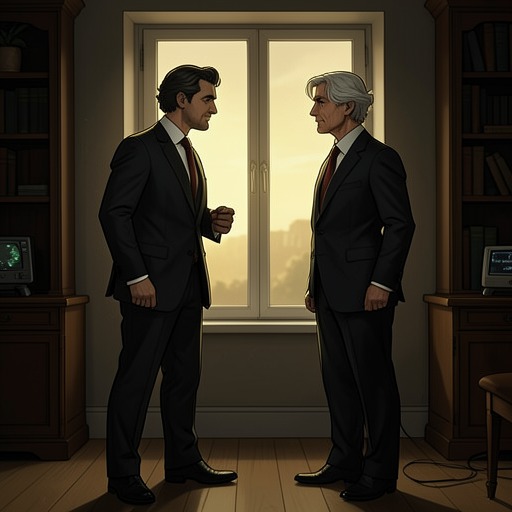
The candle-lit library is the manor’s principal social room and the place where preparation, drinking, conversation, and spectacle overlap. Before the guests arrive, Theodore Nott and Draco Malfoy conduct a final walkthrough there. Draco checks the bar and counts the Firewhiskey bottles, while Theodore sends a stack of books back onto the shelves with his wand and reviews the guest list. Their exchange contrasts domestic labor with inherited expectations: Theodore wonders why house-elves cannot do the work, but Draco insists that his mother, Narcissa, had always believed the host should perform the final inspection.
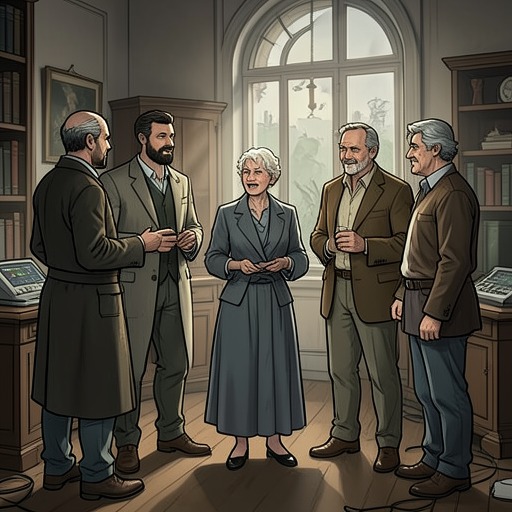
Once the guests assemble, the library becomes a crowded public stage. Hermione observes Neville beside her and resolves to protect him from any remaining Slytherin cruelty, while the presence of Harry Potter and Ron Weasley anchors her within a familiar group. Yet the library also enables her to withdraw from that group. After flirting and champagne weaken her decision not to investigate the books, she spends more than fifteen minutes wandering through the stacks. The noise of the party gradually disappears, and the shelves create a temporary world of silence in which curiosity overcomes caution.
At the end of an aisle, an arched doorway appears to promise a secret chamber or hidden object. Hermione hesitates repeatedly before opening it, only to discover an ordinary room. Draco Malfoy is waiting behind her and laughs at the anticlimax, mocking her apparent attempt to search the manor for dark dealings. The moment turns the library into a playful trap: its books and secluded alcove invite investigation, but the real discovery is Draco’s presence and his awareness of Hermione’s movements. The space allows him to watch her without the social exposure that would accompany an approach in the center of the party.
The Werewolf Game and Spatial Secrecy
The library later becomes the setting for Pansy Parkinson’s Werewolf game. She distributes enchanted role papers that will burn after being memorized and explains that the group includes one werewolf, one healer, and villagers. During each “Full moon,” the werewolf identifies a target, and the werewolf is granted legilimency solely for the game. These rules give the party a formal excuse for suspicion, concealed knowledge, and intimate proximity.
Hermione objects that the game reinforces the false idea that werewolves are inherently violent and frightening. Her protest briefly interrupts the party’s entertainment, but Pansy dismisses it as excessive seriousness and sends a cocktail toward her instead. The disagreement is characteristic of the manor’s social order: a moral argument is absorbed into a game, while the game itself becomes a mechanism for testing boundaries that the participants would not openly acknowledge.
Draco uses the game’s rules as cover for approaching Hermione from behind and whispering into both ears. He asks whether the rules prevent him from touching her, kissing her, or taking her upstairs. Hermione struggles to answer while maintaining the appearance of participation, then admits that she does not always play by the rules. In the crowded library, the house provides concealment without true privacy; her friends remain close enough to call out, while the game gives Draco a plausible explanation for his proximity.
The tension continues when Hermione appears to lose track of the game and Draco takes over the deductions. He identifies Ginny Weasley as the werewolf and then publicly hints at possible pairings among Neville Longbottom and Pansy Parkinson, and Ginny Weasley and Blaise Zabini. He finally challenges Hermione by asking whether she will meet him in a broom closet. His insinuation makes the library’s public character decisive: what has been private between them is converted into a spectacle before their friends. Hermione, embarrassed and furious, storms away, while Harry Potter and Ron Weasley notice her departure from their chess game.
Corridors and the Balcony
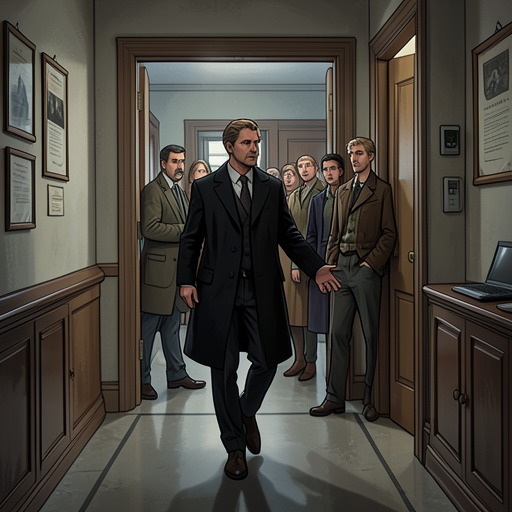
Draco follows Hermione through the manor rather than allowing the party to absorb the conflict. He suspects she has remained in the house because she would not abandon her friends, and he finds her through a slightly open balcony door after catching sight of her caramel-colored skirt. The door closes loudly behind him, marking the transition from the social room to a more secluded threshold. Hermione immediately tells him that he is still an ass and announces that she has questions, but the setting confirms that her anger has not erased her desire to confront him privately.
The balcony becomes the manor’s most important transitional space. It is open to the night air but separated from the party by a door, so it combines exposure and shelter. Draco and Hermione kiss there, and the physical intensity of the encounter begins to outrun Hermione’s control. When he lifts her against the balcony and her skirt falls away from her thigh, she breaks the embrace, returns her feet to the ground, and insists that events are moving too fast. She does not reject the attraction; she rejects the location and pace, determined to proceed on her own terms.
Harry Potter then enters through the balcony doors while looking for Hermione with Ron Weasley. Hermione masks the encounter by saying that she and Draco were merely talking, and Harry responds with disbelief at the prospect of a friendly conversation between them. The interruption restores the public world at exactly the moment the balcony has made private feeling visible. Nott Manor thus repeatedly forces the pair to negotiate not only what they want, but also who might see them wanting it.
Narrative Significance
Nott Manor’s rooms form a progression from performance to disclosure. The library holds the formal party, the guest list, the drinks, the books, and the Werewolf game; its alcoves permit covert observation but not complete escape from an audience. The corridors enable pursuit after Hermione’s public humiliation. The balcony permits their first kiss while preserving a physical connection to the party through its door and interruptions.
The manor also changes meaning as Hermione’s and Draco’s relationship changes. At first it is an intimidating Slytherin environment into which Hermione must summon the will to enter. It then becomes a maze that rewards curiosity with Draco’s teasing presence, a game board where rules authorize flirtation, and finally a private threshold where Hermione establishes a boundary. Later, when Draco pauses their renewed encounter to explain that his interest is not merely an artifice for getting her into bed and that he wants dinner and a future morning beside her, the earlier spaces are reinterpreted: the manor’s games and hidden corners may have begun as provocation, but they have led to a confession that Draco insists is real.
The location’s decisive function is therefore relational rather than merely atmospheric. Nott Manor does not hide Hermione and Draco from the social world completely; instead, it places them close to friends, rules, doors, and interruptions, forcing desire to emerge through performance and then survive its exposure. Its architecture turns movement through the house into movement through uncertainty: each threshold carries them farther from inherited hostility and closer to a relationship that, as Draco finally tells Hermione, is no longer a game.